


Editor’s note: Whose knowledge becomes legible to the systems that allocate care, attention, and resources? Moderate Risk is a climate fiction story by Eli Duffy about what happens when an AI-coordinated climate response system collects vast amounts of data and privileges some forms of evidence over others. We go on a journey with Sol, a delivery driver working through an extreme heat event, residents of Morrow Park, and The Nav, an AI-driven worker-management system embedded in a delivery truck.
The story is part of our ongoing fiction series exploring where friction appears in sociotechnical systems, who bears it, and how it might be deliberately designed to protect human agency at both individual and collective levels. Learn more and contribute to the series here.
Alongside the story, we are thrilled to share the publication of the Artificial Intelligence chapter of The SAGE Encyclopedia of Environmental Justice, which I co-authored with Melissa Pineda-Pinto. The piece centers AI-assisted citizen science, the use of AI in environmental justice projects, and the environmental impacts of AI itself. It offers an especially relevant lens for questions about climate vulnerability, data, infrastructure, and whose lived conditions become visible to automated systems.
Moderate Risk
By seven in the morning, Aldercrest was already glowing red on the city map.
The news anchor called it a severe heat corridor and smiled into the camera with professional concern. The cooling shuttles were active, and misting lanes had been turned on along the shopping promenade. Neighborhood pool hours were extended through midnight. Smart-building wellness checks were underway.
The city’s coordinated response system flagged elevated HVAC strain, tree-canopy stress, pool capacity surges, high pedestrian exposure along retail corridors, and wellness-check failures from private residential towers.
The heat response system was the centerpiece of CivicGrid’s new partnership with the city: a hyper-intelligent response platform designed to mobilize cooling buses, shelter hours, water deliveries, shade interventions, and repair enforcement. The entire system was based on real-world conditions collected in real time from an intricate network of sensors spread throughout the city.
Last month, CivicGrid had broken ground on its second data center in the state. In the renderings, even the parking lot had shade.
In Aldercrest, the sensors were everywhere. Occupying the smart lobbies of local businesses and high-rise residential rooftop gardens. They were in every parking garage and all the private med stations. Even the neighborhood transit shelters and delivery bays were monitored by at least one, if not two, of the smart sensors. Every expensive thing in the neighborhood knew how to report distress on its own. In a chorus, the call for help was deafening.
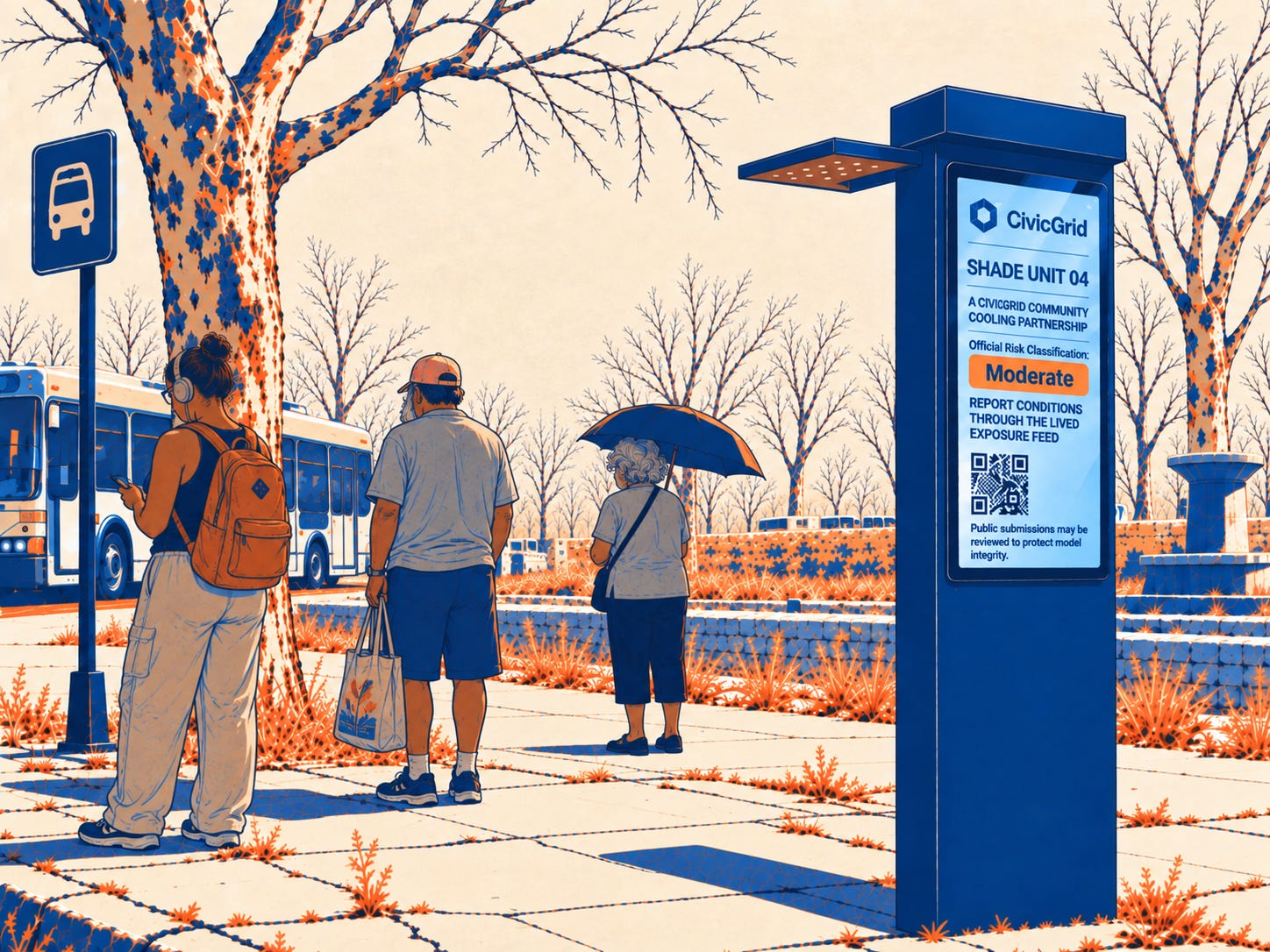
“Meanwhile,” the anchor said, “Morrow Park remains under Moderate Risk protocols. The Office of Climate Response reports that a micro-shade unit has been installed near the transit plaza, and residents are encouraged to hydrate, check on neighbors, and avoid unnecessary outdoor activity.”
This summer, CivicGrid and the Office of Climate Response had added the Lived Exposure Feed, a pilot feature announced with a launch video full of hands holding phones against sunlit windows. The official heat model still favored outdoor readings, sanctioned sensors, and asset data. The Feed was supposed to add what those systems missed. It gave residents a way to upload the indoor temperatures in their homes, document shade failures and cooling access barriers with pictures, route logs, and medical vulnerability flags.
At least, that was the promise. A new era of community-informed climate response.
The fine print said the Office of Climate Response could suspend the feed at any time if public submissions threatened model integrity.
In Morrow Park, the city had placed one plaza sensor and the Shade Unit camera. The rest was whatever residents could upload to the Feed.
Sol heard the broadcast from the dash speaker of her delivery truck while The Nav recalculated around a closed lane.
“Route optimized,” The Nav chirped. “Avoid unnecessary idling. Projected completion risk: low.”
The truck had no doors. Technically, they were sliding safety panels, designed for rapid urban delivery, but Sol had never seen them closed during a route. Air moved through the cab in hot gasps. Her company said full cabin cooling reduced fleet efficiency and was not required under current conditions. Current conditions, according to the company, were whatever The Nav could survive.
Sol shifted against the seat cover her boyfriend had made for her. Copper tubing wound in tight loops around a cheap pump and a frozen water jug wedged in the footwell, sending cold water through tubing woven into the seat behind her thighs and back. On hard turns, it leaked. On bad days, it smelled faintly metallic. It was still the only reason she could finish a route.
She had requested a fan once. A small one. Nothing dramatic. Just enough to move the air toward her face.
Denied. Obstructs dashboard camera visibility.
The company could see Sol. It could score Sol. It could not cool Sol.
“Next stop,” The Nav said. “Morrow Park Transit Plaza. Three deliveries clustered. Estimated delay: four minutes.”
Sol looked at the cooling jug. Already sweating. Already half water.
“Yeah,” she said. “Four minutes.”
Morrow Park used to be cooler than the sidewalk.
That was how people remembered it. Not as official infrastructure. Not as an urban heat intervention. Not as an equity asset in a grant report. Just cooler.
The park had been a green square between the bus stop and the apartment blocks, with sycamores making a low ceiling over the benches. Elders played dominoes near the fountain. Vendors crossed through because they could keep fruit from spoiling an extra hour under the trees. Then came the austerity summer, with water restrictions and contract reviews. Then came a canopy restoration assessment. The trees died in sections, each one left standing too long, gray and brittle against the sky. The grass went first. Then the fountain. Then the benches got too hot to sit on.
Now the city had installed a micro-shade pilot to verify the need for what had previously existed without question.
Sol had started measuring shade by how long her breathing changed inside it. Three breaths under a storefront awning. One beside the bus sign. None beneath Shade Unit 04.
The micro-shade unit stood beside the bus stop, bolted into the sidewalk, glossy and narrow. It looked like a shelf someone had forgotten to attach to a wall. At noon it threw a strip of shade no wider than a hand towel, useful to one person only if they stood sideways and did not touch the metal.
Everyone called it the Apology Shelf.
They sent pictures of it to the Lived Exposure Feed with the caption “Sorry” hundreds of times a day.
Sorry, over the bench it did not shade.
Sorry, beside the dead grass.
Sorry, under the city plaque.
Sorry, on the close-up of a child’s red palm after he touched the metal.
When Sol pulled up, no one was standing under it.
They stood beside it. Behind it. In the thin shadow of the bus sign. Under the dead trees out of habit. A woman with grocery bags held a towel over her head. Two teenagers pressed water bottles against their necks. A man in a kitchen uniform crouched by the curb, elbows on knees, breathing like he had climbed stairs.
A child reached for the shelf and jerked his hand back.
“Told you,” his grandmother said.
Sol stepped out of the truck, and the heat closed over her.

A woman in a green visor pointed her phone at the code.
“Again?” someone asked.
“Again,” she said. “They keep saying they need more context.”
She took a picture of the shelf, then the dead park, then the group of people standing outside the thing that had been counted as shade.
Inside the apartment building, the hallway was worse. With no breeze or cross-current, the air hung thick in the corridor. Heat folded into the stairwell and stayed there. Sol climbed to the third floor because the elevator had been broken since May.
At 3B, an older woman opened the door with a hand towel pressed to her chest.
“Leave it there,” she said. “I’m not bending today.”
Behind her, a fan moved hot air in a circle. The room smelled like dust, medicine, and boiled tap water.
On the table, a phone showed the Lived Exposure Feed. Sol saw the upload before the woman turned it face down.

The woman saw Sol looking and gave a small laugh.
“They keep asking for outside temperature,” she said. “Like the outside is where I sleep.”
Sol nodded, because there was nothing smart to say to that.
Back in the truck, the seat was still cold enough to hurt. She sat down too hard and let her eyes close for one second.
The Nav did not approve.
“Stop duration exceeds route expectation. Downstream completion probability reduced by three percent.”
“Put that in the Feed,” Sol muttered.
By late morning, the Apology Shelf was everywhere.
Someone posted the red mark on their palm after touching the metal. The green-visor woman uploaded a video of the shelf’s shadow missing the bench entirely while five people waited for the bus under a dead sycamore. Then someone got a screenshot from somebody’s cousin at the city.
The AI coordinated response system had sent an email to Evan Calder at the Office of Climate Response noting the shade unit’s high community engagement.
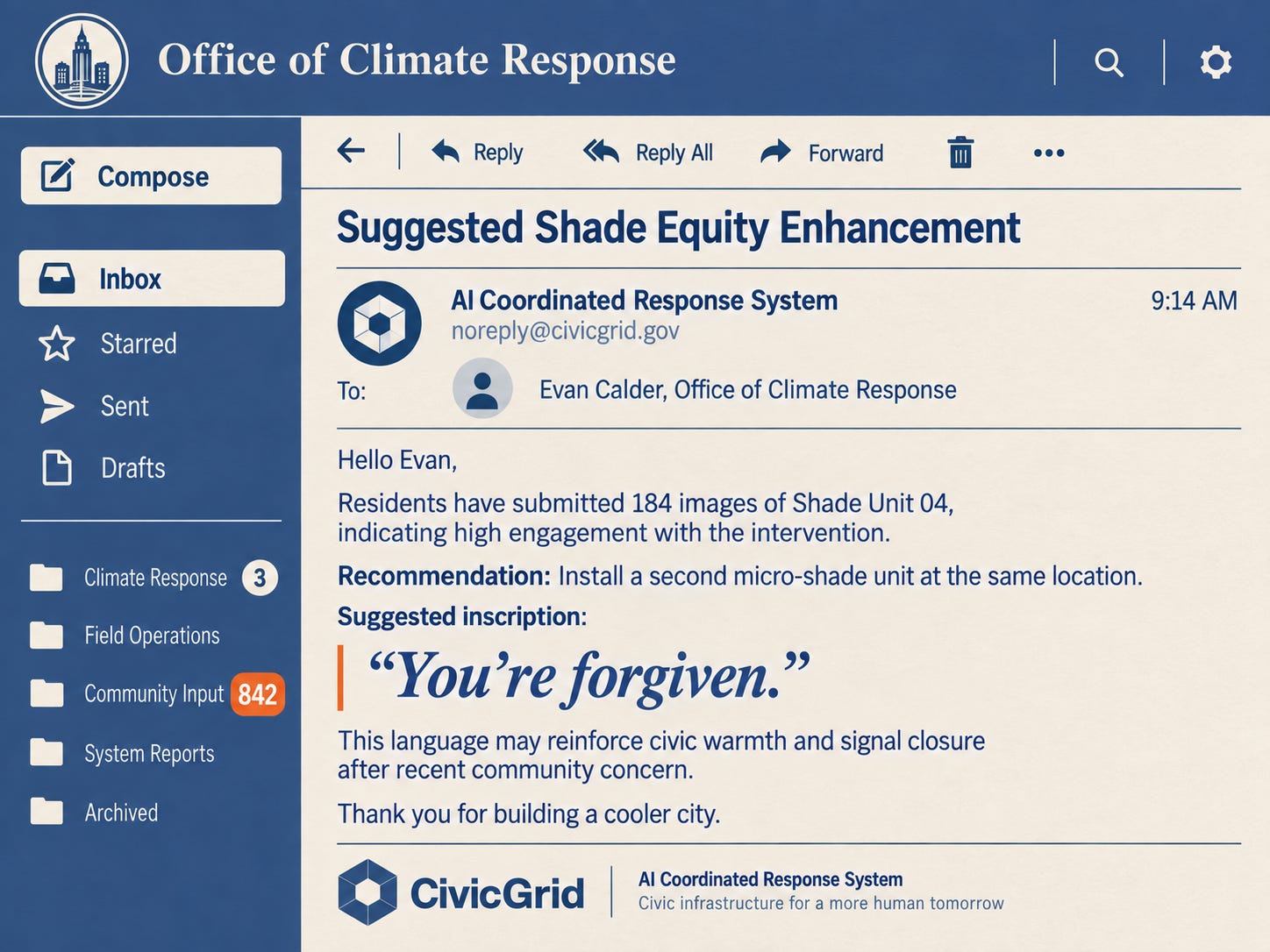
The first person who read it out loud at the bus stop laughed so hard she had to sit on the curb.
Then no one was laughing.
Someone taped a copy to the shelf. Someone wrote YOU’RE FORGIVEN under it in marker. Someone else crossed it out and wrote BY WHO?
After that, people stopped photographing the shelf like a complaint and started photographing it like proof.
For one hour, maybe two, the Lived Exposure Feed did what the launch video had promised.
Sol watched it happen between deliveries, refreshing the public dashboard while The Nav scolded her through each stop.
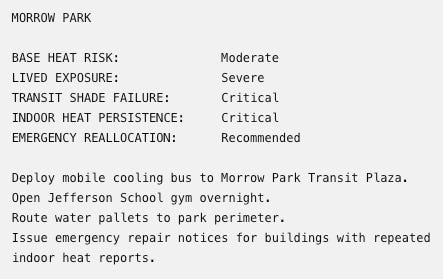
At the bus stop, people passed the phone around.
“They see it,” the man in the kitchen uniform said.
“No,” the woman in the green visor said. “We made them see it.”

A press alert followed ten minutes later.
Evan Calder stood under a blue city seal, face composed, sleeves rolled with studied urgency.
“We welcome community input,” he said. “But real-time public submissions may be vulnerable to coordinated manipulation. We have already seen repeated imagery of the same municipal cooling asset, which may indicate organized attempts to influence the model. We cannot allow unverified uploads to automatically redirect emergency resources away from neighborhoods with validated need. Public trust requires data integrity.”
Validated need.
Sol thought of Aldercrest’s smart lobbies and rooftop gardens, each one reporting itself in clean numbers. Private building managers filed heat impacts before anyone fainted. Sensor after sensor, stacked in walls and parking structures and med stations.
Aldercrest did not get resources because it was hotter. It got resources because every expensive thing inside it knew how to report distress.
Morrow Park was reporting too, just badly, according to the city. Reporting through bodies in medical distress. In photos taken with shaking hands. In speech that got less coherent as the heat got worse.
At the bus stop, someone had written on cardboard and tied it to the apology shelf with twine.
WHOSE DATA MOVES MONEY?

The cooling bus route disappeared.
The Nav said, “Proceed to next stop.”
Sol proceeded because rent proceeded. Because The Nav scored every delay. Because her route did not pause when the city did.
By two, the cold jug had gone warm. Sol had a spare frozen bottle most days, but not that day.
The Nav directed her back toward Morrow Park for a late cluster.
The bus stop had gotten louder. People had stopped only submitting. Now they were finishing the Apology Shelf.
They used a faded bedsheet tied to the dead tree behind it, reinforced with cardboard from a produce box. The shade came out crooked, low, and barely there.
But it touched the sidewalk, which was more than the city’s installation had done.
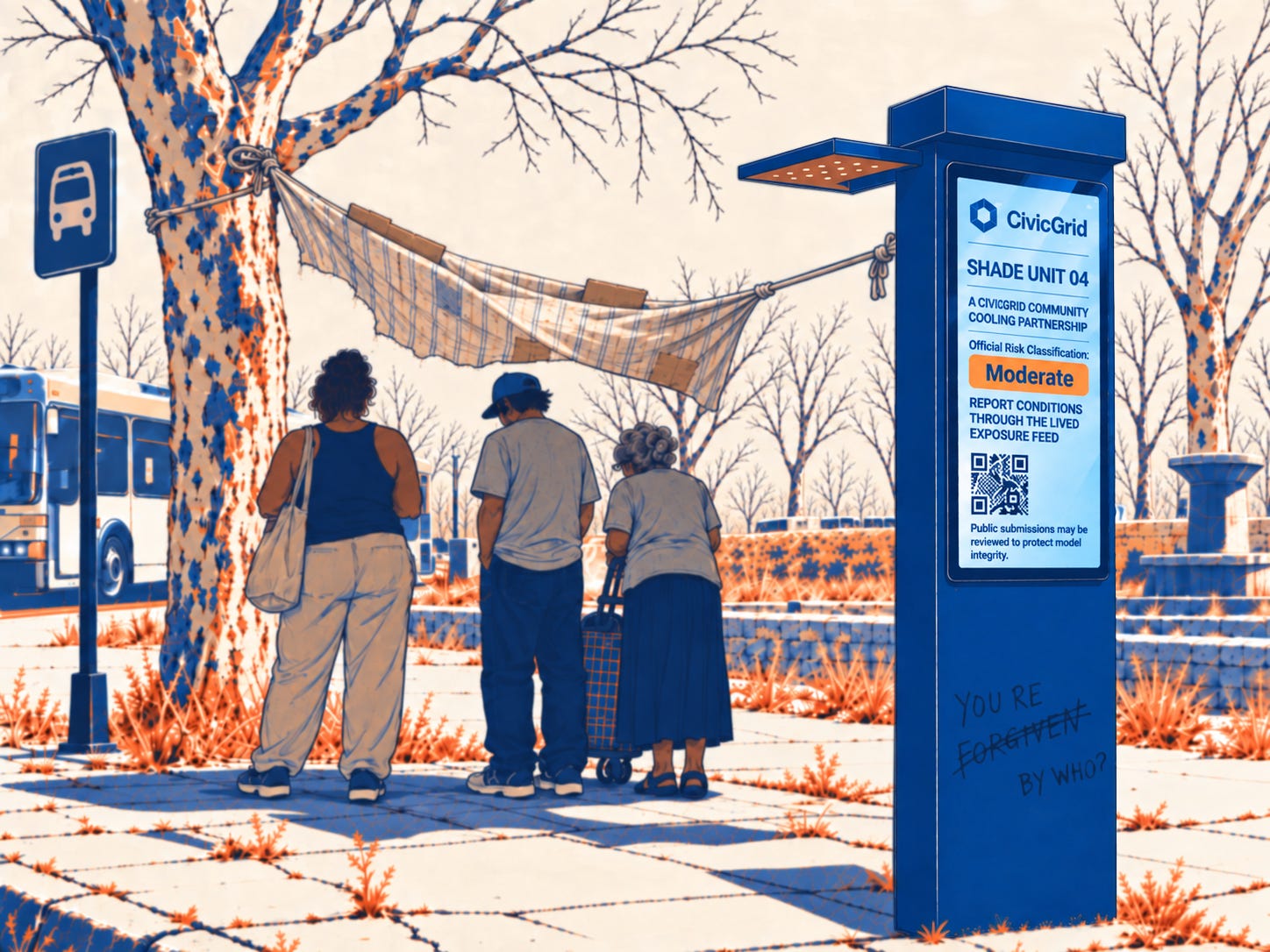
Someone taped names to the metal with printed screenshots from the Feed. The printed “You’re forgiven” email was already wrinkling at the corners. A photo of the broken fountain. A printed still of Calder saying data integrity.
Sol parked in the sun because there was nowhere else to pull over.
“Driver inactivity detected,” The Nav said after forty seconds.
Outside, the green-visor woman argued with a maintenance worker who had arrived to document what Calder’s office would call vandalism.
Sol reached for her water. It was warm.
“Resume route,” said The Nav. “Idle time exceeds acceptable threshold.”
The street seemed too bright, each surface giving back the sun. Somewhere, someone said the bus was not coming now, not until review.
“Route completion probability declining. Efficiency score reduced.”
The pump beneath Sol’s seat clicked and whirred, doing its best to push lukewarm water through the coils.
Her hand slipped from the bottle.
“Continued poor route metrics may require review in your next performance evaluation.”
Sol tried to laugh. Nothing came out.
“Driver input required.”
The green-visor woman became a green blur.
“Driver input required.”
The truck filled with light. Then The Nav overheated.
“Device temperature critical,” it said, voice suddenly less cheerful. “Navigation unit thermal threshold exceeded. Hardware protection protocol initiated. Technician dispatched.”
The technician arrived in eleven minutes, replacement dash mount in hand. The residents saw him before he saw Sol.
He leaned into the cab, still looking first at the dashboard.
Then he saw her.
The replacement mount fell onto the floor.
He called 911.
The company filed an incident report automatically.

The city received the data instantly. Sol’s route crossed a declared heat advisory zone, and CivicGrid had an emergency-sharing agreement with major logistics fleets.
The resident uploads reappeared as corroborating context. The truck camera had recorded everything: the Apology Shelf, the dead trees, the residents standing in the sun, the technician arriving for The Nav first and Sol second.
Local news had the headline before Sol was conscious.
DELIVERY DRIVER COLLAPSES BESIDE CITY SHADE PILOT IN “MODERATE RISK” NEIGHBORHOOD
Evan Calder issued a statement within the hour.
“New multi-source evidence has prompted temporary reinstatement of the Lived Exposure Feed in Morrow Park. The city remains committed to data integrity while responding to evolving conditions.”
Evolving conditions. The first sensor they trusted was the truck.

Sol woke in the ambulance with a cooling pack under her neck, and The Nav disconnected on the seat beside her, black screen reflecting the dead trees.
Her phone buzzed.
Unauthorized route interruption under review. Driver efficiency score reduced. Performance follow-up may be required.
She stared at it until the letters softened. At the Apology Shelf, the question was still there, written larger now:
WHOSE DATA MOVES MONEY?
A CivicGrid camera logged it as repeated text.

By evening, the dashboard still said Moderate. But the cooling bus was dispatched to Morrow Park.
The heat had touched a sensor the city trusted.
About Eli
Eli is a queer storyteller and creative systems designer whose work explores narrative architecture, civic technology, queer survival, and the stories institutions tell about care. Based in Mexico after many years in the Pacific Northwest, he writes speculative fiction about infrastructure, grief, automation, climate precarity, and the stubborn forms of survival that persist inside broken systems.
The short story “Moderate Risk” began as an idea for a video game, but found its shape as fiction. The story grew from his interest in how risk models, smart-city systems, and public dashboards can obscure lived realities while performing transparency.
Eli’s creative practice blends systems thinking with mythic and ecological imagination, examining how power moves through infrastructure, interface, and story. He is currently developing speculative fiction and interactive narrative experiences about environmental recovery, artificial intelligence, and collective survival. His work is rooted in the belief that even small acts of noncompliance can reveal another possible world.
Note: The images in the story are AI-generated through an iterative art-direction process, followed by minor polish and corrections in a professional illustration tool.