
Synthetic Creativity
What a malfunctioning storytelling AI reveals about overreliance, governance, and the market for automated culture

Editors’ Note: What happens when AI is marketed as a substitute for human creativity and connection but fails to deliver meaningful value? In the story below, Nikki Hekmat explores this question at the boundary between the real and the speculative. Nikki is a Political Economy student at UC Berkeley and a 2026 AI Safety Policy Fellow with the Berkeley AI Student Safety Initiative. She wrote this piece in response to our call for Legal Fiction as Institutional Imagination. Read on and share your thoughts.
A Lost Art
Angry clouds darkened the sky as rain drowned the world. Henry squinted through the windshield of his gray Honda, immediately regretting having missed his eye exam the week prior. Work was demanding late nights from him again—lawsuits against tech companies as their new LLMs wreaked havoc in consumer’s lives. And then there was the host of suits in reverse, of corporations buying out everyday aspects of society and transforming them into something mechanical.
Henry pulled into the driveway of his beige townhouse. Across the street, where children once laughed and played on swingsets and climbing walls, stood the ongoing construction of a new virtual reality center. “VISIT THE GREAT OUTDOORS, BUG FREE” one sign read, next to “VR PLAYGROUND, COMING SOON.” He shook his head, glancing away before he could dwell on it too much.
He fiddled with his umbrella as he opened the side door, but couldn’t escape the gust of wind that sent droplets into his glasses. He scurried inside, shutting the door swiftly behind him. The heat of garlic and rosemary enveloped him, and he nearly slumped in relief.
“What’ve you got on the stove, Stacy?” he called, unwrapping his scarf and shrugging off his coat.
Stacy wheeled in, her white chef’s hat adding a touch of warmth to her chrome metallic frame. The robot blinked once, twice, then chimed in her usual monotonous voice: “It is your favorite, Mr. Henry. As requested.”
Henry’s smile didn’t quite reach his eyes. “Lamb again? I don’t deserve you.”
There was a beep as Stacy processed his words before speaking again. “Ha. Ha. Anything else, Mr. Henry?”
“No, that’ll be all. I’ll just go and get comfortable.”
Stacy beeped, then wheeled away. Henry pounded towards the living room—ah, Stacy had taken care of that as well. The hearth crackled in greeting, his shoes had been piled neatly in the corner, and the files that had been pouring out of his briefcase were now organized neatly on the coffee table.
He’d first purchased the droid when his ex-wife left him for an AI boyfriend. Tomás was everything she’d dreamed of and more, she’d told Henry. Much easier than dealing with human feelings, or so she’d tried to convince him. Last he’d heard, they’d gotten married on a beach somewhere. Tomás’s generated family was even in attendance—and as a bonus, they didn’t add any costs to the wedding.
Henry’s pride never quite recovered after that.
Stacy brought over a plate of steaming rack of lamb over a bed of buttered broccolini and herbed potatoes. Henry nestled into his favorite armchair and spooned heapfuls into his mouth, sighing in pleasure. He’d had to set the programming to only two desserts a week; otherwise he’d have gained twenty pounds by now. Veronica had never cooked this good, and Stacy never left him a single dish to clean. But after a long day at the office, there was one thing he still wanted.
Licking his lips, he called out, “Hey Stace, where’s Scribe? Tell him to come out here.” A beep echoed from the kitchen. “As you wish, Mr. Henry.”
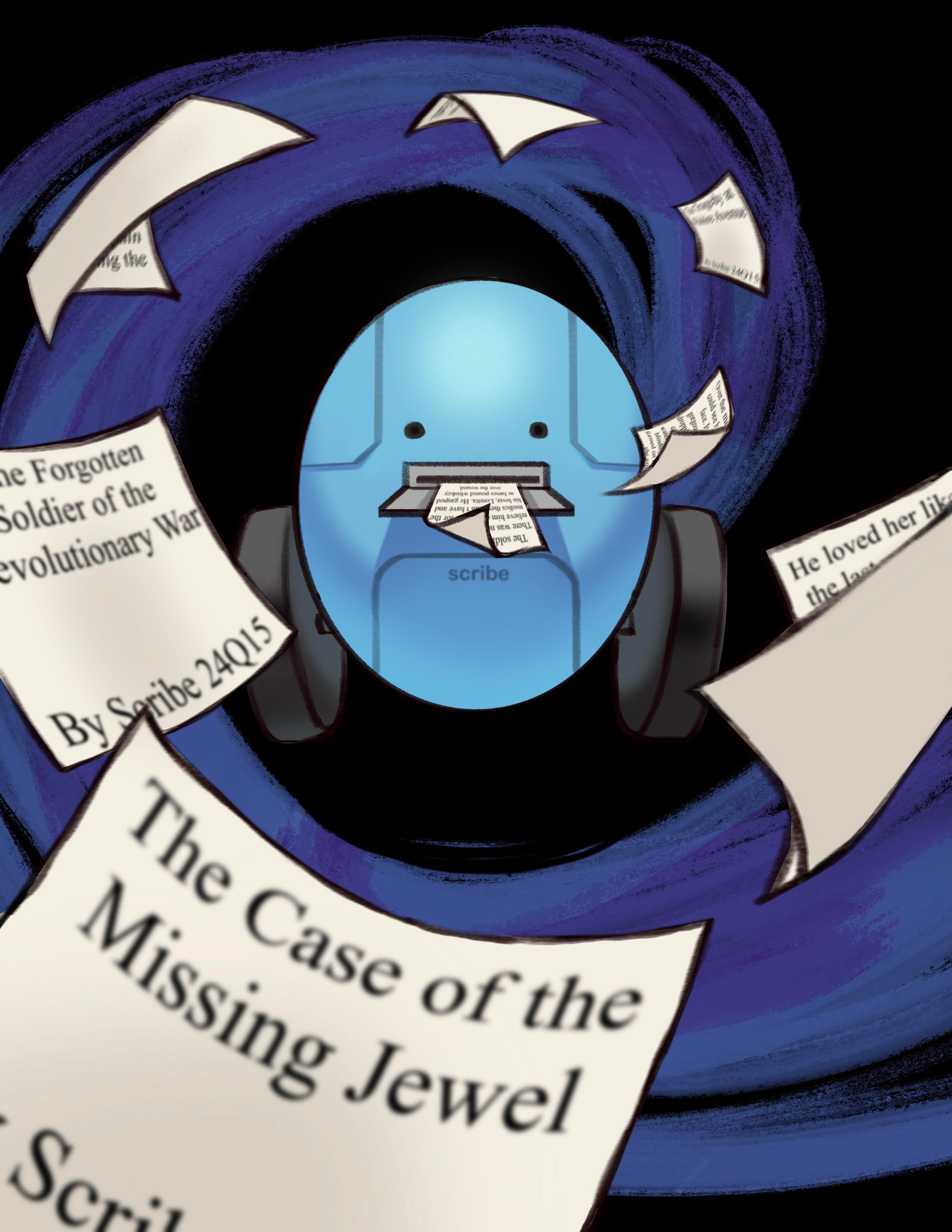
A few seconds later, Scribe wheeled in. Henry always smiled at the sight of his little friend: just a few feet tall, with a round blue body, and two metallic gray eyes. Scribe’s printer
protruded from his midsection, just under the keypad. Henry would have to have Stacy clean that again soon.
“What would you like to read today, Mr. Henry?” the droid asked.
“Hmmm.” He drummed his fingers on his tray table. “How about a good mystery? Something new, eh?”
Scribe beeped in confirmation, then closed his eyes. A quick melody followed, like the gentle quartet you’d hear in an elevator. Several pages printed out of Scribe and onto his tray, and then the music stopped as he opened his eyes.
“The Case of the Missing Jewel, by Scribe 24BQ15. Chapter 1.”
“Good boy, Scribe.” Henry patted Scribe on the head, and the droid chirped in response. He gathered the papers in his hands and began reading.
Not three minutes later did Henry feel his eyes starting to droop. He tossed the papers on the floor with a harrumph. “C’mon, Scribe, you can do better than that. The main character has the exact same name as the last story. Let’s try historical fiction.”
Scribe beeped once, then twice. “My apologies, Mr. Henry. One moment please.” That melody grinded out again. It took Scribe an extra minute this time, but six pages eventually shuffled out, and he opened his eyes.
“The Forgotten Soldier of the Revolutionary War, by Scribe 24BQ15. Chapter 1.” Henry gave it a try, but was bored after another few minutes. Why couldn’t Scribe produce anything fresh? He’d been darn expensive, that was certain. But everything sounded like
his usual stuff—it was the same archetypes and expositions, just in different formats. Henry’d assumed this model of Scribe had been programmed with a bit more capacity for creativity than that.
He tossed the other chapter aside, ordering a romance this time. The chapter came, this one about two lovers with warring families. But the writing was bland, and the ending was implied within the first few sentences. He tried fantasy, next sci-fi, and then comedy—but each plot was simpler than the last. Nothing original, nothing that hooked him.
When that blasted melody poured out of Scribe again, Henry had had enough. “Just stop!” he roared.
Scribe beeped in response, staring blankly.
Henry got to his feet to power Scribe off and grab the phone. He punched a few numbers, waited a beat, and then a warm voice greeted him.
“Good evening,” the woman said with a southern drawl. “This is Loretta speaking from Scribe Incorporated. How can I help you today?”
“Hi Loretta, I’m calling because I’m unhappy with the service from my Scribe. None of its stories are entertaining anymore, and I’d like to return it.”
There was a long pause.
“Why, I’m ever so sorry to hear that,” Loretta cooed. “I’m afraid we cannot offer a full refund—”
“That’s not acceptable! It’s not delivering as promised.”
Another pause, and then Loretta’s tone softened. “Oh, sir, I deeply apologize—” “I don’t need an . . . wait.” Henry’s brows furrowed, realizing Loretta seemed to abruptly cut off each time he interrupted her. “Loretta?”
“Yes, sir?” Loretta asked brightly, her tone completely changed from before. As if she had reset.
“Oh, God,” Henry groaned. “I’m speaking to an AI assistant, aren’t I? Loretta, get me a real human on the phone.”
A long pause—likely Loretta processing the information. “I’m sorry, sir, but there isn’t a human available right now. I’m happy to assist however I can—”
Henry slammed the phone down, seething. He doubted there was even an in-person office he could bring the crappy droid to, since most companies worked remote these days. The way this night was going, maybe he could reset some of Stacy’s program to get ice cream.
He kicked the mantle in frustration, then cursed, clutching what was sure to be a bruised foot the next day. But as he scolded himself internally, his eyes caught an object that had fallen off a shelf in his anger.
On closer inspection, it was a novel from his childhood. The yellowed edges of Harry Potter and the Sorcerer’s Stone brought a smile to his face—he’d forgotten he even owned human-authored books anymore. He bent down, brushing it off, before bringing it back to his chair. On his ninth birthday, his father had surprised him with his own copy of the book so he wouldn’t have to keep checking it out from the public library. Henry’d slept with it each night, and had it nearly memorized in a week’s time. It had inspired him to read more and more. Yet as he grew older, and as life threw more responsibilities his way, he’d lost the time to read quality works—and now they were all out of circulation.
He cracked open the spine and began scanning the iconic first chapter. Images of his mother reading to him before bed filled his mind. She would pull each character off the page with different voices, animated facial expressions, and wild hand gestures. When Henry had been working on his reading skills, she would challenge him to sound out the words he struggled with.
He realized, then, that he could never imagine Stacy or Scribe reading to him with the same passion.
Now, years later, he found himself cackling at the same twists and turns in the book. Harry’s adventures with Ron and Hermione, discovering himself in an unfamiliar world, finally feeling a sense of belonging—it was all so magical. It captured true child-like wonder.
As the firelight dimmed, Henry felt his eyes grow heavy. The clock on the wall read 1:20 AM, and he marked the page he’d left off on halfway through the novel. He sat back with a deep sigh, staring out the window.
The rain continued on, pattering against the glass. The VR playground had taken his view of a copse of magnolia trees. His brows furrowed as he tried to picture their full petals in the springtime, the magenta blossoms open to the world for only a brief stretch of time. But the image was half-formed, already becoming a long-forgotten memory.
His eyes drifted to Scribe in the corner, a frown dragging at the corners of his lips. The droid’s bright eyes were now black and dull after being powered off. Its body was stiff, unmoving. It was just a hunk of metal and programming, filled with parts and chips shipped over oceans to culminate into a disappointing heap in the corner of his California home. Even the greatest minds in the world couldn’t create something remotely human.
How had society fallen so low? How could Scribe have possibly been marketed to him as a replacement for real human literature? His artificially engineered chapters could never compare to the dance one feels with a writer as you connect with them across time and space, simply through the bundle of ink and paper between your palms.
“It’s not your fault, buddy,” Henry whispered to Scribe’s blank screen. “It’s not your fault at all.”
About Nikki
Nikki Hekmat is a second-year Political Economy student at UC Berkeley with a minor in Creative Writing. On a pre-law track, she hopes to help regulate AI to protect the intellectual property of creatives, artists, and storytellers. Nikki is a 2026 AI Safety Policy Fellow at the Berkeley AI Student Safety Initiative (BASIS), serves as President of Bowles Hall, the oldest residential college in the United States, and works as Chief of Staff for a senator within the Associated Students of the University of California. She is passionate about AI governance, protecting creative ownership in the digital age, and advancing thoughtful policy at the intersection of technology, law, and the arts.
About the Friction
This work engages with a world where the intellectual property and creative capacity of authors and storytellers are no longer honored. The story surfaces a subtle but powerful friction between the promise of generative AI and the lived experience of its users. Marketed as a replacement for human creativity, the storytelling robot Scribe produces endless content but fails to deliver originality, emotional depth, or genuine connection. As Henry confronts bland AI-generated stories and an automated customer service system that cannot meaningfully respond to his complaint, the narrative exposes a growing policy tension: when AI systems are sold as substitutes for human cultural production, who is accountable when they fall short? The story invites readers to reflect on the regulatory gaps around AI products, consumer expectations, and the social value of human creativity in an increasingly automated world.
 | A guest post by
|