
Newsfeed Notification: Legally Blind Eyewitness to Alleged Murder Confounds Legal Precedents
A journalistic-style news report from 2035.

Editors’ Note: A speculative journalistic-style news report from 2035 by Kevin Hunt, Senior Lecturer at Nottingham School of Art & Design. His short story is in response to our call for Legal Fiction as Institution Imagination. Read on and share your thoughts.
Reported by K.J. Hunt, Bluestar Post, 28 July 2035.
Amid ongoing speculation about the death-by-poisoning of crypto billionaire and government contractor, Arkturo Pine (54), further complications have emerged due to a potential eyewitness in the investigation being registered as legally blind.
Samantha Ballard (36), who is being publicly named for the first time as a witness, is registered as legally blind and wears ‘future sensing’ generative AI glasses as a visual aid. The glasses, which are part of the Dragonfly Eyewear brand manufactured by Kapung Systems, stimulate real-time images for the user through a neural interface.1
The Poisonous Moment
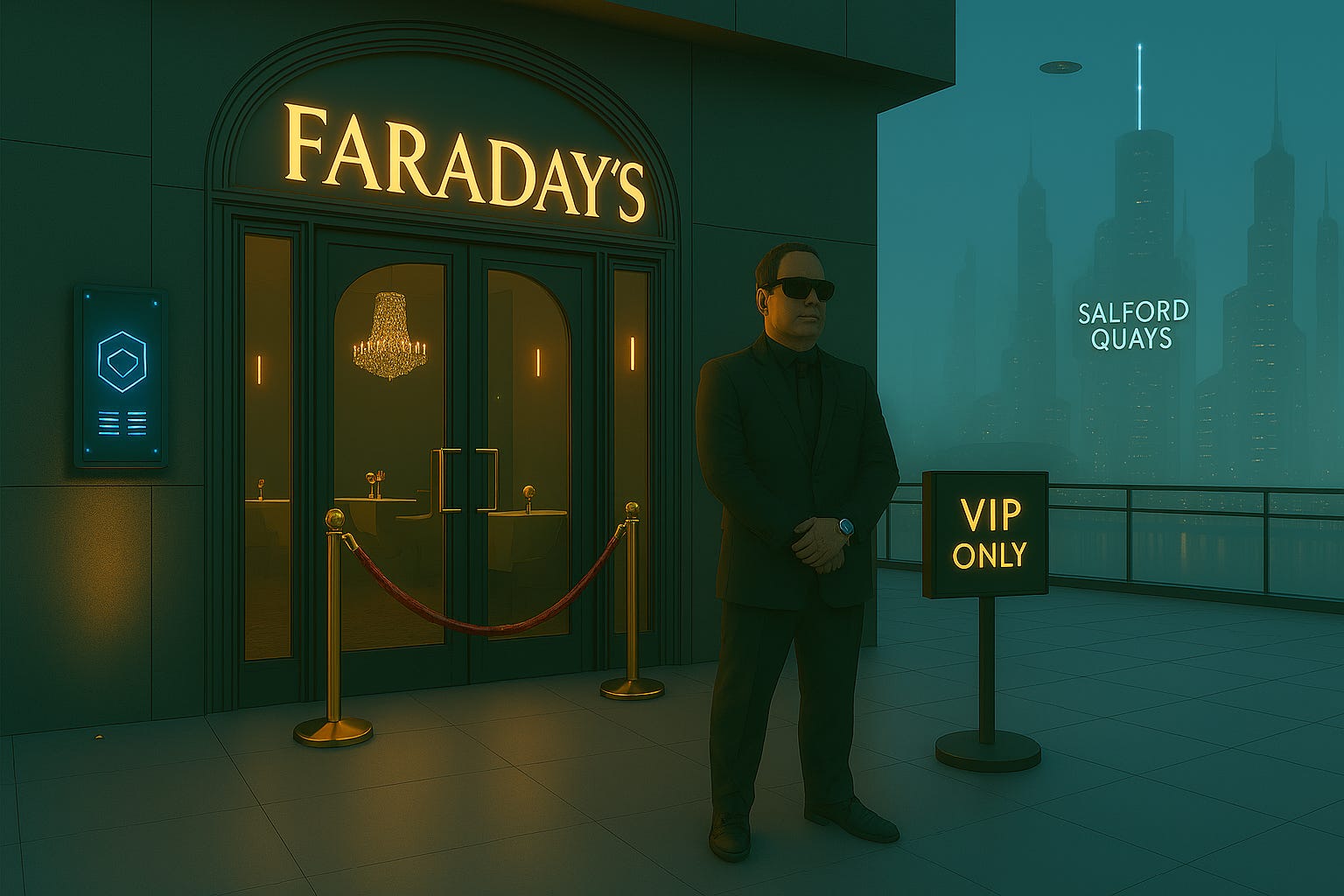
Pine became gravely ill during the evening of 16 July while waiting for a dinner guest to join him at the exclusive Faraday’s Club in the New Salford district of the UK. The club, situated within the Salford Quays Freeport Zone managed by Arkturo Future Industries, is well known as a meeting place for socialites, celebrities, and tech entrepreneurs. The club strictly limits its membership and is regarded as an urban retreat for elite society.
After collapsing at his table, Pine was rushed to a bespoke medical facility managed by the Fountainhead Eternal Wellbeing (FEW) partnership. Despite the best efforts of both human and augmented medical practitioners, who initially stabilized his condition, Pine died while undergoing an invasive detoxification treatment.
Ballard was seated at a table near the victim. Her testimony suggests an as-yet-unidentified member of Faraday’s staff, believed to be an agency worker rather than a permanent employee, was seen to drop something into Pine’s drink. Salford Authority for Freeport Enforcement (SAFE) believe this is when a fast-acting poison was dispensed, suggesting information shared by Ballard has become integral to the ongoing investigation.
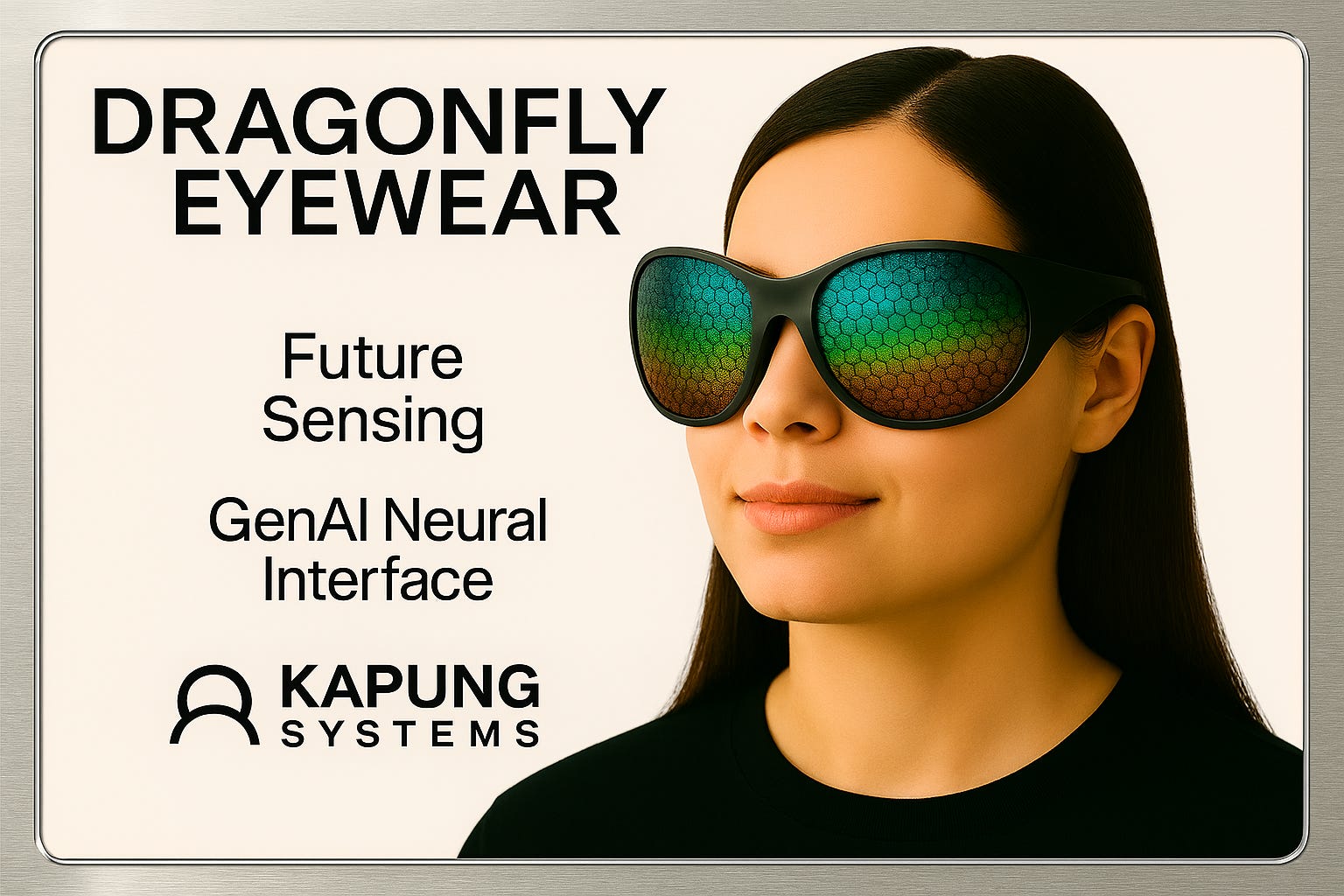
AI ‘Future Sensing’ Eyewear
Future sensing eyewear works by scanning the surrounding area to formulate a mental image in the user’s mind. Once the wearer initiates the scanning process, the future sensing programme generates a data stream that adapts in real-time, supported by AI world generation,2 to relay information directly to the user’s visual cortex3 through a neural interface. The data stream constantly modifies in response to any form of movement, whether undertaken by the wearer or otherwise occurring in the surrounding area.
Typically, the glasses draw selectively upon networked information to construct parts of the data stream, responding to changes in the immediate space of the user. However, Faraday’s prides itself on being an “organic oasis” that prioritizes “an atmosphere of confidentiality and intimacy for human social experiences.” The club operates with a special dispensation that allows them to limit or block all forms of networked activity and government surveillance, exempting them from the UK Data Mapping and Sovereign Security Act (2030).
Faraday’s Club and the Luxury of Privacy
The entire club is constructed as a 21st century update of the Faraday cage, which prevents anyone inside from connecting to an external network. Furthermore, as part of its commitment to “the ultimate private dining experience for our patrons,” the club publicly states it does not operate any internal surveillance cameras or sensors that would negatively impact its membership.
When Faraday’s opened, in September 2031, it was lauded by Civil Liberty and Privacy Protection groups as a step in the right direction towards resistance to government and corporate surveillance. The club was simultaneously criticized for only offering membership on a highly selective basis, leading to it being branded “a luxury rights playground for the rich” and “a new kind of obscure institution created by the elite to avoid accountability.”
Within the limited information available about Pine’s murder, Ballard has subsequently emerged as the only witness to what happened in the moments before he collapsed. She is currently under protective custody as the investigation unfolds, due to her now public status as a potential witness to the crime scene.
The Legal Conundrum
When being worn, Dragonfly Eyewear essentially blindfolds the user and makes them reliant upon an experience of sight processed by the future-sensing operating system. Kapung Systems has suggested that if a user is legally blind, this can be disregarded as a factor when considering their visual experience, providing “the process of seeing is understood primarily as an act of data transfer.”
Current legal practice does not include any precedent for AI-enhanced synthetic vision being presented as eyewitness testimony from someone registered as legally blind. This issue is currently being debated and contested by a range of experts, with input from specialist areas including neurology, computational science, and jurisprudence.
A representative for Kapung Systems stated, “Within controlled laboratory tests, Dragonfly Eyewear is more accurate than standard human vision to a consistent equivalent of 20/15 vision, at minimum.” This means the glasses enable the wearer to selectively focus upon and see things clearly from 20 feet away, which someone with standard organic vision can only see clearly from 15 feet.
The company further argues their Dragonfly Eyewear provides objective visual data that is more consistently reliable than an organically sighted eyewitness because it can be extracted for independent review.
Whether the data extraction process has been undertaken in relation to Pine’s death is unclear. However, Kapung Systems has indicated that a clause in the contract for Dragonfly Eyewear ultimately gives the company proprietary ownership of all data, including extraction rights, into perpetuity. The company states this is clear from the contract terms and that data is only used for research and development to anonymously improve user experience.
Controversy and Complexity
In addition to heated political discussions about the motive behind Pine’s murder, which has spawned numerous conspiracy theories, Ballard’s status as a legally blind eyewitness creates further complexity.
As selected details of the operating system for Dragonfly Eyewear have been leaked into the public domain, Organic Rights Activists (ORAs) have been challenging the already controversial privacy concerns related to Neural Interface Technologies (NITs). Such concerns focus upon both the breach of privacy due to the way third parties and their actions become incorporated into the data stream, as well as potential loss of privacy for the wearer. The news that all data is ultimately owned by the manufacturers appears to have come as an uncomfortable revelation to many users, who were not fully aware of the details within the contract clauses.
Alongside the privacy concerns, long-term critics of NITs argue that future sensing AI generative software programmes are fundamentally flawed. The world-generating programmes that feature in many NITs are reliant upon sophisticated forms of probability modelling. Critics argue that, in effect, this means the programme hallucinates a significant part of the mental imagery stimulated for the user.
Synthetic Vision or Digital Phrenology
Neurologist and organic life campaigner, Ofelia Sage, has frequently stated that future sensing technologies have “evolved from a process more akin to digital phrenology4 than human cognitive processing, and should be regarded with substantial scepticism.” Sage has gone as far as to suggest, “some of the future sensing programmes, despite their laboratory credentials and research budgets, offer little more than a pseudoscientific experiment in creative image making.”
Sage has publicly challenged claims made by Kapung Systems in the past, specifically the reliability and accuracy of their future sensing eyewear. One of the challenges is that the core functionality of the future sensing operating system is black-boxed, with requests for transparency rejected due to an Intellectual Property embargo with an undisclosed end date.
Other challenges to NIT programmes focus upon the lack of distinction between what is being “stimulated”, whereby data is transferred directly into the occipital lobe5 to stimulate the visual cortex, and what is being “simulated”, which is a software-based process of image creation based upon predicted outcomes rather than live empirical data.
Consciousness as Hallucination?
Neurobiological studies confirm that human cognitive processing of organic vision, based upon normative visual and cerebral functionality, operates through a partially predictive model. The human experience of consciousness is, to some extent, created in the moment and is informed by probabilistic expectations, synaptic responses, and reactive adaptations. It is this model of organic information processing that future sensing software attempts to recreate as a synthetic process.
While laboratory tests undertaken by Kapung Systems, and other companies using neuro-interface technologies, record high levels of task achievement and goal-oriented outcomes – including in military and defence contractor live exercises – it is extremely challenging to fully determine the consistency and accuracy of neurologically simulated vision due to each user experience remaining at least partially subjective.
Crucially, the neural interface in Dragonfly Eyewear is not a one-way processing system that functions only as a sensory tool to inform user experience. To communicate and adapt in real-time, aspects of the user’s cognitive processing must feed into the data stream to align data processing with movement perception.
A Neurological Negotiation
What the user “sees” as a mental visualisation when wearing the eyewear is described by experts as a type of “neurological negotiation” between the user’s organic sensory perception and the sensor-based simulation, which is processed through the future sensing programme.
Put more simply, the sensory expectations, memories, and variable capacity for mental visualisation of any given user of Dragonfly Eyewear, and similar NITs, may potentially influence what that user “sees” at any moment. Such influences are typically very subtle and are highly unlikely to include unrealistic or unfeasible perceptions. However, there are instances of targeted hacking and viral infections that have instilled “nightmare-like” visions, creating substantial confusion and distress for the user.
Kapung Systems has challenged the idea that hallucinations are a significant problem, claiming that many of these issues have been substantially resolved to a high level of functionality and security. However, they have conceded that small variations can occur in scenarios where the neural interface system must create data to fill a gap in knowledge when the scanning software, or other similar limitations, cannot complete a full three-dimensional picture of the environment.
The company has previously commented that this element within their Dragonfly Eyewear range is akin to the blind spot in normative human vision, whereby the mind seamlessly fills in the blank spot caused by the optic nerve, and that their product is at least as reliable as organic human visual experience.
Nevertheless, due to the way the neural interface functions, Kapung Systems acknowledges that the allegedly objective data stream produced by their future sensing system would require third-party external corroboration from additional sensors or scanners operating as surveillance monitoring. Such information, which is not available due to the incident occurring at Faraday’s, would allow the generative AI-informed scenario experienced by Ballard to be matched with and thereby verified by comparison with a secondary record of events.
The debate about synthetic vision as a reliable source of information is ongoing, with the Pine murder case providing a testing ground for legal procedures that may lead to the redefinition of which kinds of information and data are judicially accepted as “eyewitness” testimony.
The Origins of Dragonfly Eyewear
Readers should be aware that Dragonfly Eyewear did not originate as a visual aid for people with sight loss.
Kapung Systems originally developed a range of hyper-sensory interactive goggles as wearable tech for military applications, including the capability to quickly alternate visuality across an expanded light spectrum that included infrared and ultraviolet. In combat situations, these alternate visualities provided an enhancement tool for tracking body heat and other similarly targeted functions within high-risk situations.
As the product evolved, the Dragonfly Eyewear design has been adapted for the consumer marketplace. This included settings to provide alternate visual experiences, loosely based on simulations of insect sight and configurations that allow the user to approximate the visual experience of various animals. Branded as an educational toy, these iterations of the product included the ability to “see” like a pit viper snake or with the compound eyes of a dragonfly.

As NIT software programmes became more sophisticated, including improved functionality of the neuro-interface interacting with the visual cortex, the eyewear design was further adapted to operate as a day-to-day visual aid for people with sight loss. The functionality of the product has continued to evolve, but Kapung Systems has historically been cautious about making substantial claims regarding the reliability of Dragonfly Eyewear as a consistently accurate record of lived experience.
The murder of Pine with Ballard as the sole witness has now become a significant test for the operability and reliability of Dragonfly Eyewear, with substantial societal and technological ramifications beyond solving this already complex and controversial crime.
Disclaimer
This is a work of fiction. Names, characters, businesses, places, events, and incidents are either the products of the author’s imagination or used in a fictitious manner. Any resemblance to actual persons, living or dead, or actual events is purely coincidental.
Copyright © 2026 by Kevin J. Hunt. All rights reserved. No part of this story may be used or copied in any way without written permission from the author, except for brief quotes in reviews or articles.
About Kevin
Kevin Hunt is a writer and researcher at Nottingham Trent University, UK, where he is Senior Lecturer in Culture and Context as well as Director of Doctoral Programmes for Nottingham School of Art and Design. He has a background in Film and Literature and a PhD relating to American modernist painting. Kevin researches and writes about cultural and creative practices that explore multisensory experiences, including collaborations with My Sight Nottinghamshire and Nottingham Contemporary art gallery. His work embraces aspects of posthumanism and the ongoing negotiations with media and tech that are constantly redefining our ways of thinking and being.
About the Friction
This fictional news report engages with the friction between technology, consciousness, memory, and the notion of objectively agreeable facts in a post-truth environment. It is a response to AI and various forms of algorithmic and computational processing being embedded within our communication systems and urban environments, with substantial influence over social and political discourse. It is also a response to ongoing discussions about AI as a pathway to a synthetic form of consciousness (AGI and superintelligence) and the potential of neural interfaces to support, enhance, disrupt, and reshape human sensory experiences in a wide variety of ways.
Our ongoing negotiations with technology, which are open-ended, promise vastly improved accessibility, inclusivity, and enhanced capabilities and opportunities, while also threatening ever-tighter forms of regulation, judgment, and surveillance. The imagined scenario in the story is intended to prompt consideration of the many kinds of boundaries being (potentially) crossed as AI-related technologies become increasingly commonplace.
A neural interface provides a direct communication link between the brain's electrical activity and an external device, such as a computer or robotic limb.
AI world generation technology enables the generation of photorealistic virtual environments that can be moved through and explored in real-time.
The visual cortex is the part of the brain responsible for processing visual information. It plays a crucial role in interpreting what we see.
Phrenology is a pseudoscience, influential in the 19th century, which measures bumps on the skull to predict mental traits.
The occipital lobe is located at the back of the head and is the smallest lobe of the brain. It is primarily responsible for visual processing.
 | A guest post by
|